
How to Check Criminal History in Keota
A Keota record check works best as a sequence. City Hall is the published local contact and can address a city-held record or identify the proper custodian. The Keokuk County Sheriff maintains county booking and jail information. Iowa Courts Online shows public filed cases, while Iowa DCI supplies a separate, fingerprint-supported Iowa repository response. Those sources overlap, but none replaces the rest.
Before contacting Keota, write down the incident date, location, report or case number if known, and the exact item sought. Ask about fees, identity or authorization needs, redaction, delivery, and timing because the city publishes no dedicated police report form or copy schedule. Never treat a council-minute activity count as a substitute for the underlying report.
- Contact Keota City Hall about a city-held police report or municipal document.
- Describe the existing record precisely and ask who is its legal custodian.
- Check the Keokuk County jail roster or call the sheriff for a Keota booking or current custody question.
- Search Iowa Courts Online for filed Keota charges and their outcomes.
- Order an official Iowa name check from Iowa DCI when a statewide repository response is needed.
Keota Police Activity Appears in Council Minutes
Keota’s official February 6, 2023 council minutes provide an uncommon local view: periodic police activity summaries. They list 20 complaints or service calls and three citations. Categories include assistance and service, animal calls, vandalism, a civil dispute, an accident, a miscellaneous investigation, disorderly conduct, harassment, assault, and a reported rape. These are labels in a city meeting record, not findings about any named person.
The minutes are useful for understanding what kinds of work reached the council report during that period. They do not provide incident narratives, arrest names, booking status, filed charges, dispositions, or annual totals. A requester who needs one Keota event should ask City Hall for the underlying releasable record rather than relying on the summary line.
Measure the right thing: A call can end without an arrest, a citation is not a conviction, and a council reporting period is not an annual crime rate.
The Keota Police Department
Keota’s code defines police-chief powers, and the city minutes report police activity. Yet the official materials reviewed do not publish a separate police department page, records-unit address, online report form, arrest portal, blotter, copy price, or response time. The verified public contact is Keota City Hall. Ask the city whether it holds the report or whether another law-enforcement agency is the custodian.
A good Keota request names the event date, time and location, report number if available, and the specific document or portion sought. Include contact details and a preferred format. Ask the city to confirm any cost and release condition before sending payment. Active-investigation facts, juvenile material, victim details, and protected identifiers may be withheld or redacted even when another part of the report is open.
Keota Calls Are Not Criminal History Totals
Keota council minutes count broad police work. Assistance calls, animal matters, accidents, civil disputes, and investigations can all appear beside offense labels. That mixed list explains why the total cannot be called a crime count. It also cannot establish how many people were arrested or convicted. One call may generate no reportable offense, while one incident may involve several records.
Official crime statistics require a defined agency, time span, geography, and measure. The Iowa DPS Uniform Crime Reporting program uses incident-based data and supports custom reports through Crime Data in Iowa. A researcher should select Keota or the relevant agency and year, then label incidents, offenses, arrests, victims, or property accurately. The research did not extract a stable annual Keota series, so the periodic minutes must stay in their limited role.
- Service call
- A request for police help or response; it does not by itself prove an offense.
- Citation
- A formal allegation or notice that may lead to a filed court matter.
- Arrest
- Custody under legal authority; it is not a determination of guilt.
- Conviction
- A judgment of guilt after a plea or verdict in court.
Arrests and Bookings in Keota
Keota publishes no city jail or booking log. When a Keota arrest is booked into the Keokuk County Jail, the Sheriff’s “Who’s in Jail” page becomes the official current-custody snapshot. It updates twice daily after 3 a.m. and 3 p.m. and lists booked date, name, age, sex, charge description, and bond. It does not show the arrest narrative, exact time, arresting officer or agency, court date, booking number, or release date.
Use the roster for current custody, then call the Keokuk County Sheriff at 641-622-2727 if a recent event may fall inside the update gap or the visible fields are too sparse. Request the incident or arrest report through its originating agency. Once a prosecutor files charges, Iowa Courts Online and the clerk become the sources for the case and outcome. The Keokuk County arrest history page gives the full county channel sequence without turning a Keota allegation into a conviction.
Note: A roster charge describes an allegation at booking and may differ from the prosecutor’s later filed charge.
Three Keota Activity Periods Compared
Three city meeting records illustrate why dates and labels matter. April 2021 minutes reported 41 calls or complaints and nine citations. November 2022 minutes reported 24 calls and four citations. February 2023 minutes reported 20 calls or service complaints and three citations. The figures come from separate reporting periods, but the research does not establish equal duration, matching category rules, or annual coverage.
| Meeting record | Calls or complaints reported | Citations reported | Safe interpretation |
|---|---|---|---|
| April 2021 minutes | 41 | 9 | Periodic police activity summary |
| November 2022 minutes | 24 | 4 | Periodic police activity summary |
| February 2023 minutes | 20 | 3 | Periodic police activity summary |
The table supports no claim that Keota crime rose or fell. Different periods, call types, reporting choices, and later case outcomes can change the meaning. Use the minutes as a municipal record that points toward specific source material, then use an agency report, booking record, court file, or UCR dataset for the question actually being asked.
Keota Municipal Court Records
Keota has no municipal criminal court. Iowa abolished municipal, mayor, and police courts when it unified the trial system in 1973. A criminal or local-ordinance matter filed from Keota proceeds in Iowa District Court. Search the statewide docket, open the blue Case ID, and then contact the Keokuk County Clerk for the official file, a public electronic document at the courthouse terminal, an older record, certification, or correction.
The online docket can show parties, charges, separate counts, filings, events, disposition, bond, and financial fields. Read each count. A dismissal is not a conviction, and a deferred judgment is a distinct Iowa outcome. City parking citations may not be filed with the county clerk, so City Hall remains the right first question for a purely municipal parking item.
| Court Name | Iowa District Court; no Keota municipal criminal court |
|---|---|
| Case Types Heard | Filed felony, misdemeanor, simple-misdemeanor, and local-ordinance criminal matters |
| Case Lookup Channel | Iowa Courts Online and the Keokuk County Clerk of District Court |
| What the Docket Shows | Case ID, parties, charges, filings, events, disposition, bond, and public financial data |
| Copies & Fees | Ask the clerk; county copy and certification amounts were not verified |
Keota City Hall and Sheriff Records Compared
Keota City Hall and the Keokuk County Sheriff answer different record questions. City Hall is the published route for a city-held document and for identifying the custodian of a Keota police report. The sheriff holds sheriff-created reports, county jail and booking material, current warrant confirmation, and other county law-enforcement records. Sending the same vague request to both offices can delay the answer.
| Question | Keota City Hall | Keokuk County Sheriff |
|---|---|---|
| City council minutes | Primary city custodian | Not the usual source |
| Keota police report | Starting contact and custodian referral | Only if sheriff created or holds it |
| County jail booking | Not the jail custodian | Primary verified source |
| Current warrant status | Not a verified warrant channel | Call for live confirmation |
| Filed criminal case | Not the court file custodian | Not the court file custodian; use clerk |
The Iowa District Court clerk is the third branch. Once a Keota allegation becomes a filed charge, the clerk maintains the official case file. This creator-custodian-purpose test keeps city reports, county custody, and court outcomes from being blurred together.
Where Keota Criminal Records End Up
A Keota response can create several records at different times. The responding agency creates the incident or arrest report. Booking at the county jail creates custody data and fingerprints. The county attorney decides what charge to file, and Iowa District Court creates a case-centered docket. When an arrest qualifies for state reporting and fingerprints are transmitted, Iowa DCI can add the arrest cycle and later match the reported disposition.
Record flow: Keota responding agency › Keokuk County Jail and County Attorney › Iowa District Court › Iowa Department of Public Safety, Division of Criminal Investigation
A recent Keota report may exist before a court case appears. A citation can take up to fourteen days to reach the public court portal, and a new case can take one business day. A DCI response is not a live city blotter. It may omit simple misdemeanors, no-fingerprint arrests, juvenile material, restricted deferred judgments, federal cases, and matters outside Iowa.
Keota Records Are Open Except When Confidential
The Keota city code states that municipal books and records are open on request except confidential records, citing Iowa Code sections 22.1, 22.2, and 22.7. That language creates a direct local route but not unlimited disclosure. The city can withhold or redact material protected by state law. A requester should identify the document, request the releasable portion, and ask for the cited basis when access is denied.
The Keota municipal code is the primary source for that city rule. No dedicated request form accompanies it. City Hall should be asked about the fee, identity or authorization rules, delivery format, and current timing. The absence of a posted base price does not prove that all copies are free.
- Public record
- An existing record held by a government body that is open unless a law makes it confidential.
- Custodian
- The public office responsible for the record and the access decision.
- Redaction
- Removal of protected details while the releasable part of a record remains available.
- Confidential record
- Material withheld under a statute, court rule, or other lawful restriction.
Keota City Hall Opens the Record Door
The official Keota website publishes the City Hall phone and email and is the verified local source shown below.
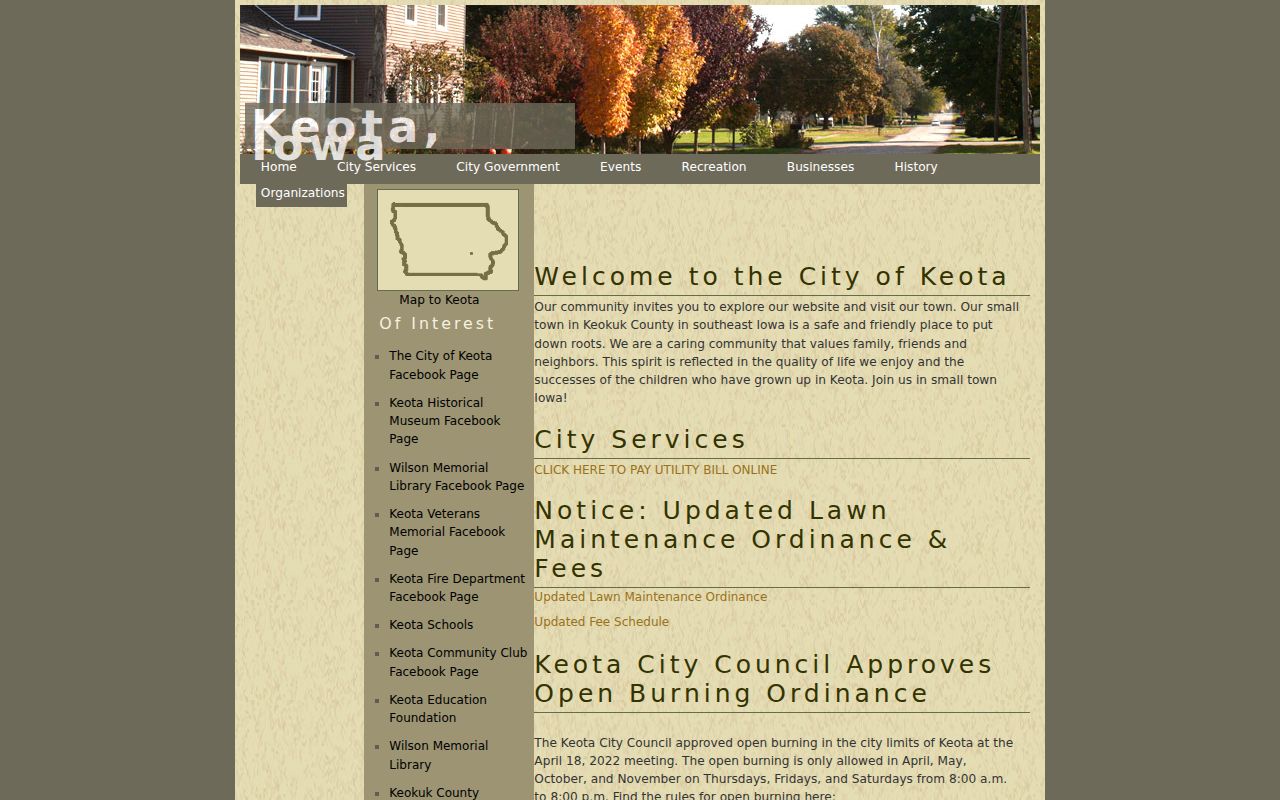
The city view supports direct contact for Keota-held records while making no claim that a city search portal or online police form exists.
Keota’s 2020 Census population was 897, placing it third among the county’s incorporated communities listed by Keokuk County. That number provides civic scale, not a crime predictor. The city’s minutes and direct contact channels carry more practical value for a record request than a population-based guess. For county custody, the Sheriff’s Office at 204 S. Stone Street in Sigourney is the verified source. For a filed case, the Clerk of District Court at 101 S. Main Street in Sigourney holds the official file.
Public Access Rules
Iowa Code chapter 22 governs a Keota request alongside the city code. Every person may inspect or copy a public record, subject to lawful exceptions. The custodian cannot make an in-person visit the only route and may receive a written, telephone, or electronic request. Iowa law allows reasonable actual expenses and calls for reasonable efforts to fill requests without charge beyond copying when the work takes less than thirty minutes.
Separate rules govern criminal-history dissemination. A city report may contain details that do not appear on a public DCI response, while juvenile and other protected repository information remains confidential. Iowa expungement can make a qualifying record confidential, but it is not a general erasure rule for every conviction. Ask the office that owns the challenged data to correct it.
Key Statutes:
Iowa Code chapter 22 governs public inspection, remote requests, reasonable costs, and confidential exceptions cited by Keota’s code.
Iowa Code chapter 692 controls criminal-history reporting, public release, confidential repository information, and subject challenges.
Iowa Code chapter 901C defines qualifying expungement paths and the confidentiality that follows an order.