
Criminal Cases in the Keokuk County Courts
Keokuk County criminal cases are heard in Iowa District Court, the state's unified trial court. The Judicial Branch's official court-system guide explains that structure. One system covers felony, misdemeanor, simple-misdemeanor, and filed local-ordinance cases. District judges handle serious proceedings, while district associate judges and magistrates take assigned lower-level work. Iowa ended separate municipal, mayor, and police courts during court unification in 1973. A charge from Sigourney, North English, or Keota does not lead to a separate city criminal docket.
The Keokuk County Clerk of District Court is the custodian of the official case file. The clerk is on the second floor of the courthouse at 101 South Main Street in Sigourney and can be reached at 641-622-2210. County hours are Monday through Friday, 8:00 a.m. to 4:30 p.m. District 8 case scheduling uses 641-684-6502. The separate Juvenile Court Office, reached at 641-673-0419, handles a restricted process whose records do not appear like an ordinary adult criminal case.
Keokuk County Case IDs and Zero
Iowa's Case ID search can be exacting. The official Iowa Courts Online guide says the identifier contains 17 characters, uses capital letters, and treats the numeral zero and the letter O as different characters. Choosing Keokuk County and the correct case type is also required in that search mode. A copied identifier with one wrong character can produce no result even though the case exists.
When the Case ID fails, switch to the name or exact-date-of-birth search. Remove extra spaces, try a former surname, and use fewer letters when spelling may vary. The name search accepts a percent-sign wildcard and lets a reader choose AND or OR between names. Those tools help distinguish a true missing Keokuk County docket from a search-input problem.
How to Search Case Records
Iowa Courts Online is the first public channel for Keokuk County criminal case records. It provides an informational statewide docket rather than the official court file. Public trial-court coverage is generally available after 1998, with some earlier data. A new case may take one business day to appear, and citations can take as long as 14 days. Once present, case information updates in real time.
- Open Iowa Courts Online and choose the search mode that matches the identifier in hand.
- Search by name, exact date of birth, 17-character Case ID, or citation number.
- Select Keokuk County when the Case ID mode asks for county and case type.
- Open the blue Case ID, then read every charge count, filing event, bond entry, and disposition.
- Ask the Keokuk County clerk for the official document, an older file, certification, or a correction.
The portal supports several distinct fields, and each mode applies its own rules.
| Field label | Type | Required | Format notes |
|---|---|---|---|
| Last/Firm Name | Text | Yes, name mode | At least two letters; % wildcard allowed |
| First Name | Text | No, name mode | An initial has no period |
| Date of Birth | Date | Yes, DOB mode | Exact date required |
| County and Case Type | Select | Yes, Case ID mode | Choose Keokuk and the correct type |
| Case ID | Text | Conditional | Exactly 17 characters; zero differs from O |
| Citation Number | Text | Yes, citation mode | May take up to 14 days to appear |
The official Iowa Courts Online interface shows how Keokuk County case searches begin.
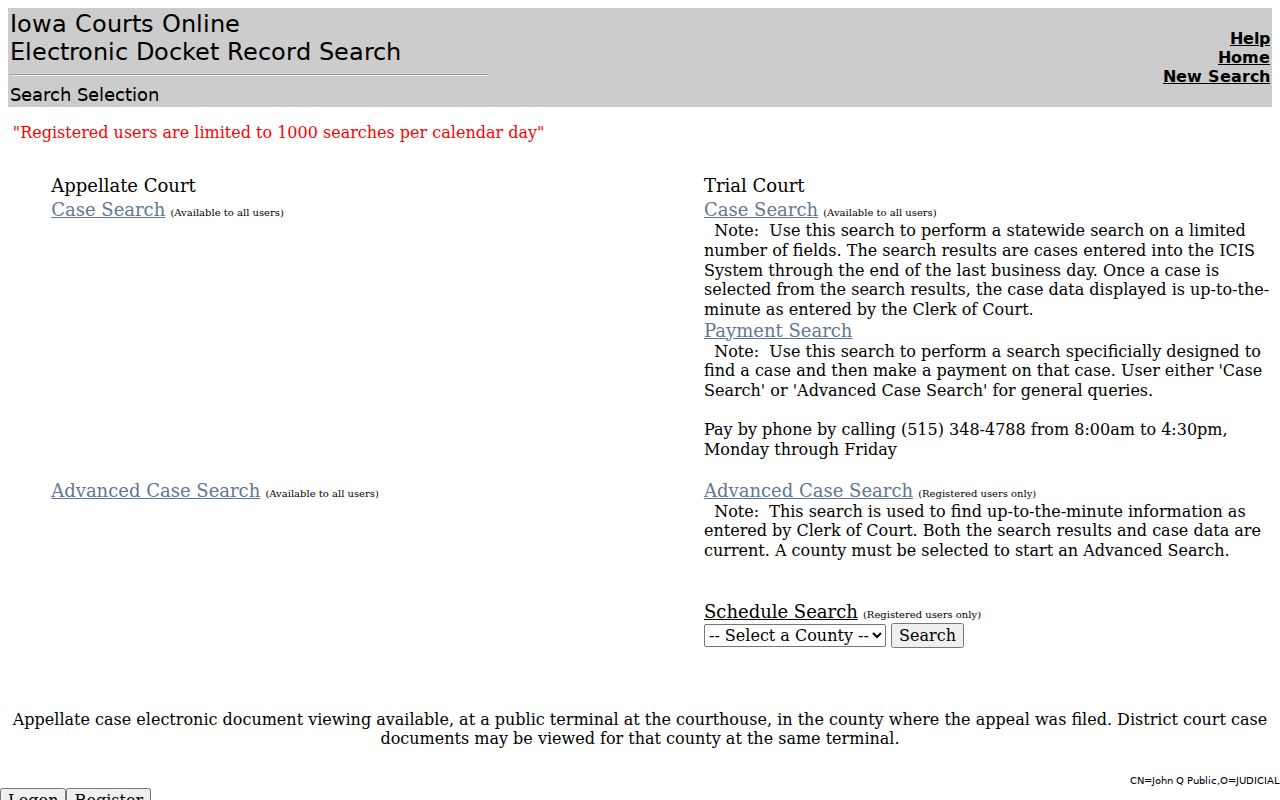
Its separate search modes explain why the best query depends on whether a reader has a name, birth date, citation, or full Case ID.
Keokuk Court Access Tiers
A Keokuk County docket may be available on the free public web, through a subscription view, or at the courthouse terminal. Bracketed links in Iowa Courts Online are public and free. Some unbracketed items call for a subscription or terminal access. Public electronic trial documents can be inspected at the courthouse terminal even when the full document is not on the open web.
The clerk's office is the right place to ask what may be copied and whether certification is available. County rules bar weapons, require phones to be switched off, and prohibit recording devices and cell-phone cameras inside the courthouse. That building rule is distinct from a person's right to inspect or obtain a lawful copy. Ask the clerk which reproduction method is permitted. No verified county source published plain-copy, certified-copy, archive-search, or subscription prices, so request the current amount before ordering.
The Keokuk County clerk page provides the courthouse contact and entry rules.
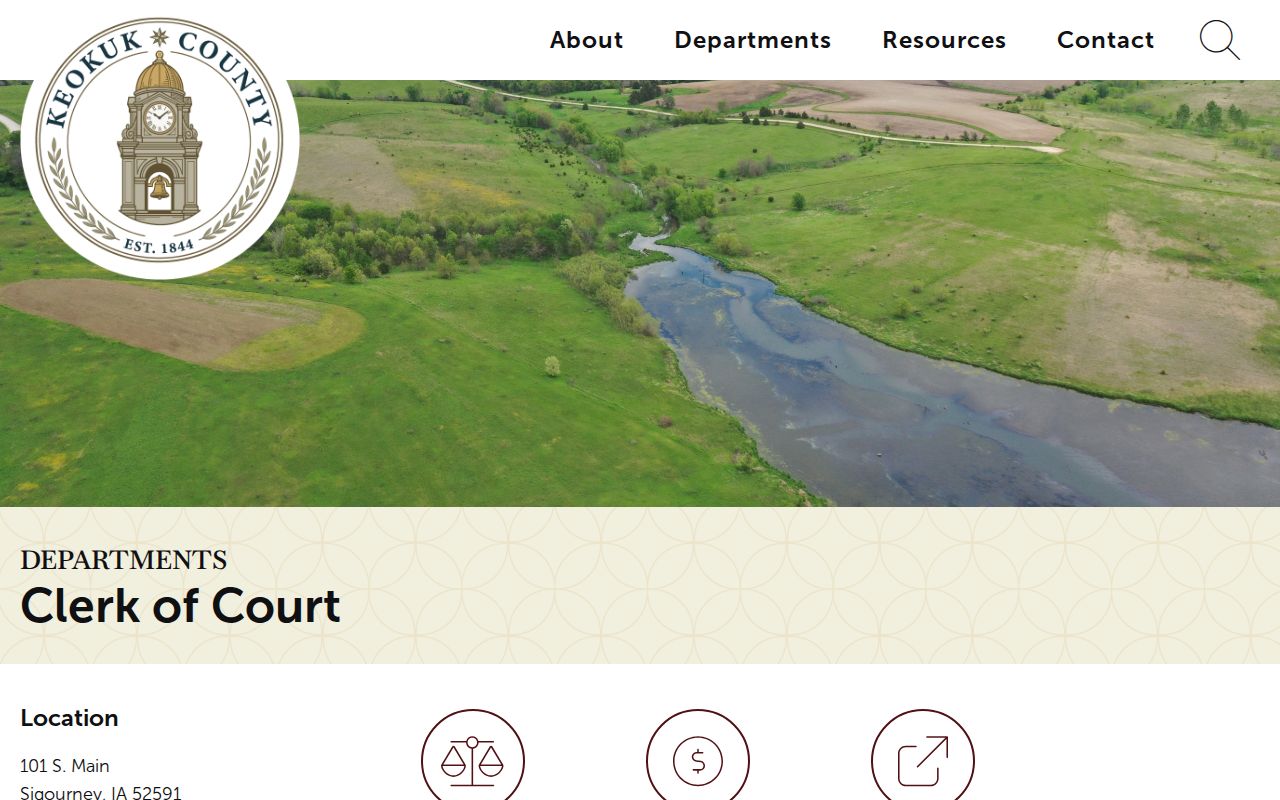
That local counter bridges the gap between an informational docket and the official Keokuk County criminal case record.
What the Case File Shows
A Keokuk County court case is built around the filed prosecution, not merely the arrest. The docket can identify the case type, judge, parties, charge codes, separate counts, filings, bond, money owed, service, and the outcome entered for each charge. The charging document may be a complaint, trial information, or indictment. Grand-jury proceedings themselves are not public just because an indictment later appears.
| Case header | Case ID, type, creation date, indexed judge, title, and long title |
|---|---|
| Parties | Names, roles, status, and public lawyer information |
| Charges | Code, count, defendant, description, and disposition when entered |
| Filings and events | Comments, event, filed date, updates, and status |
| Financial record | Costs, fine, restitution, surcharge, original amount, paid amount, and balance due |
| Bond | Agent, litigant, poster, amounts, dates, type, and disposition |
| Service and documents | Service details and available public electronic trial documents |
A financial balance is not a new conviction. It records money tied to the case. Likewise, a docket's general status should never replace the disposition recorded for each count.
Read Keokuk County Charge Counts
One Keokuk County case can contain several counts, and each count may end differently. A dismissal means that charge ended without a conviction. An acquittal is a not-guilty result after adjudication. A conviction follows a guilty plea or verdict. Iowa's deferred judgment is a distinct result in which judgment is delayed while conditions are completed, and its successful discharge has special public-release rules.
- Disposition
- The outcome recorded for a charge, such as conviction, dismissal, or acquittal.
- Trial information
- An Iowa prosecutor's formal felony charging document used in many cases.
- Restitution
- Court-ordered payment tied to loss caused by an offense.
- Recognizance
- Release based on a promise and conditions rather than the full cash deposit.
The arrest label and the County Attorney's filed charge may differ because prosecutors decide what allegation to file. The Keokuk County Attorney prosecutes state crimes and county ordinances, while the clerk records the court action. Iowa's felony punishment chapter and misdemeanor punishment chapter define classifications and limits, but the filed statute and disposition control the individual case. To trace what happened after a booking, use each filed count and outcome. The broader Keokuk County arrest history remains a separate custody trail.
Stages of a Criminal Case
A Keokuk County criminal case may begin with an arrest or citation. The court then handles the initial appearance and bond. The prosecutor files a complaint or trial information, or an indictment may issue. Arraignment addresses the charge and plea. Pretrial hearings and motions shape the issues before a plea or trial. Judgment, disposition, and sentence follow when the case reaches that point, and an appeal may create a later court record.
Case flow: Charges Filed › Arraignment › Pretrial › Plea or Trial › Disposition › Sentencing
The sequence matters because early events show allegations and process, not a final result. A warrant or bond entry can change while the docket remains online. Read by date, then confirm the latest event with the Keokuk County clerk if present status matters.
Older Keokuk County Case Files
General Iowa Courts Online coverage begins after 1998, though some earlier data appears. A missing older Keokuk County case should go straight to the clerk rather than being treated as proof that no file exists. Supply the most exact name, approximate year, known charge, and case number available. The clerk can explain archive access, public-terminal review, and copy options without promising that every historical item is digitized.
The same route applies when an online docket seems wrong. Keep the Case ID, note the field or event in dispute, and contact the clerk at 641-622-2210 or countyclerk.keokuk@iowacourts.gov. The clerk holds the official Keokuk County record and can direct a correction request. If the concern is a DCI rap sheet rather than the court docket, use DCI's separate subject-access and challenge process under Iowa Code chapter 692.
Federal Cases Beyond Keokuk County
Federal criminal cases do not automatically appear in the Keokuk County District Court docket. Keokuk County lies in the Southern District of Iowa, Central/Des Moines Division. PACER is the federal docket and document channel. It charges ten cents per page, but no bill is due when quarterly use is thirty dollars or less. Opinions and courthouse terminals are free under the published rules.
The Southern District's official venue information confirms the federal layer for Keokuk County.
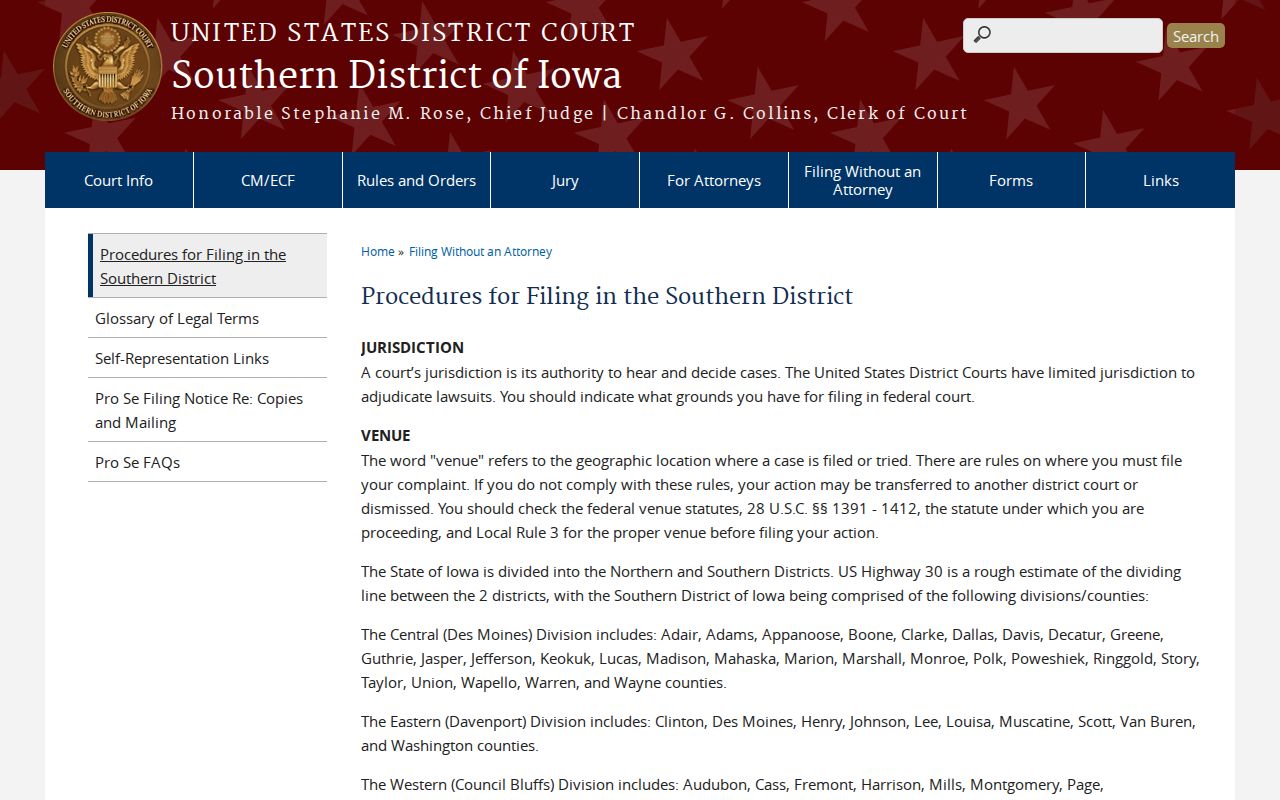
This separate venue explains why a statewide Iowa Courts Online search is not a complete search for federal prosecutions.
The federal court's official directory lists the clerk at 123 East Walnut Street, Room 300, Des Moines, with a criminal-case line at 515-323-2866. The U.S. Attorney for the Southern District of Iowa is the federal prosecutor, not the Keokuk County Attorney. CourtListener and RECAP may contain donated PACER documents but are not the complete official docket. A person reviewing their own history may need the federal docket, Iowa docket, and DCI repository because each holds a different record.
Access & Restrictions
Iowa court access is broad, but not every Keokuk County record or field is public. Juvenile matters are restricted. Confidential cases do not appear in the ordinary search, and sensitive identifiers are not public docket fields. Iowa Code chapter 22 gives access to public records while section 22.7 protects listed confidential material. Criminal-history dissemination and challenges follow the separate rules in Iowa Code chapter 692.
Iowa Code chapter 22 supports inspection and copying of public records but preserves lawful confidentiality. Iowa Code chapter 692 governs repository criminal-history access and correction.
Expungement under chapter 901C can make a qualifying record confidential, but it is not a general erasure remedy for all convictions. A Keokuk County case that does not appear may be old, delayed, confidential, juvenile, expunged, or entered under a different identifier. Ask the clerk about the official case before drawing a conclusion from an empty result.
Note: Iowa Courts Online is informational; the Keokuk County clerk holds the official court case file.