
How to Check Criminal History in Keokuk County
Begin with Iowa Courts Online when the goal is to trace a Keokuk County charge, case event, judgment, or financial entry. Search by name, exact date of birth, case ID, or citation number. The public docket is useful, but it is not the clerk's official case file. A current booking belongs to the sheriff's roster, an agency narrative remains with the agency that wrote it, and a fingerprint-supported Iowa history comes from DCI.
Names should be checked with spelling variants and a former surname when relevant. Date of birth helps separate people with similar names. If the online docket looks incomplete, the Keokuk County Clerk can provide terminal access, older material, certified copies, and help with a docket error.
- Search the state court docket and select Keokuk County where the search mode asks for a county.
- Open the blue case ID and compare the party, each count, and each disposition.
- Check the sheriff roster when the question involves current custody or a very recent booking.
- Ask the agency that created a report for its releasable copy and confirm any fee or redaction first.
- Order a DCI response when a fingerprint-supported Iowa repository check is the needed product.
The official county homepage routes readers to county departments. Its layout is shown below, and it is a sound starting point when the correct custodian is not yet clear.

The department pages separate the courthouse, sheriff, attorney, and other local offices that create different parts of a criminal record.
Two Keokuk County Record Counters
Two Sigourney counters answer very different criminal-record questions. The Clerk of District Court at 101 South Main Street keeps official Iowa District Court case files. The clerk is on the second floor and handles public-terminal viewing, older cases, certified copies, and corrections to Iowa Courts Online. The public number is 641-622-2210, and county-listed hours are Monday through Friday, 8:00 a.m. to 4:30 p.m.
The Keokuk County Sheriff's Office and Jail are at 204 South Stone Street. That office handles sheriff-created reports, booking and custody questions, local warrant confirmation, fingerprinting, and local sex-offender registration. Its main number is 641-622-2727. Going to South Stone for a certified court judgment, or to the courthouse for an unfiled incident narrative, sends the request to the wrong keeper.
Clerk of District Court
101 S. Main Street, second floor
Sigourney, IA 52591
641-622-2210
Monday to Friday, 8:00 to 4:30
Sheriff and Jail
204 S. Stone Street
Sigourney, IA 52591
641-622-2727
Monday to Friday, 8:00 to 4:30
The county contact directory shows how those offices fit within local government.

Use the directory to confirm an office before a visit, since county closure dates and contact details can change.
Note: The courthouse bars weapons and the use of recording devices or cell-phone cameras, so ask the clerk how a public document may be reproduced.
Official Iowa Background Checks
The Iowa Department of Public Safety, Division of Criminal Investigation, runs Iowa Record Check Online. A public name check costs $15 for each last name searched. First name, last name, and exact date of birth are essential. The paper form also requires gender; a middle name and Social Security number may help distinguish common names. Requests may be handled online or submitted with the official DCI request and billing forms by mail, fax, email, or in person.
This response is Iowa-only. It may omit most simple misdemeanors, juvenile material, federal and out-of-state matters, arrests for which DCI never received fingerprints, and information Iowa law bars from public release. A discharged deferred judgment is released only with the subject's signed authorization. For a person's own national identity-history summary, the official route is the FBI fingerprint process, not a county name search.
| Official service | Purpose | Published cost |
|---|---|---|
| Iowa DCI name check | Iowa fingerprint-supported repository response, filtered by state law | $15 per last name |
| Keokuk County fingerprinting | Print capture for county residents; receiving program sets the final use | $10 |
| FBI personal summary | A person's own national fingerprint identity-history summary | $18 direct FBI fee |
| Iowa Courts Online | Informational public docket, not a rap sheet | Free public docket |
The DCI method page is pictured below.
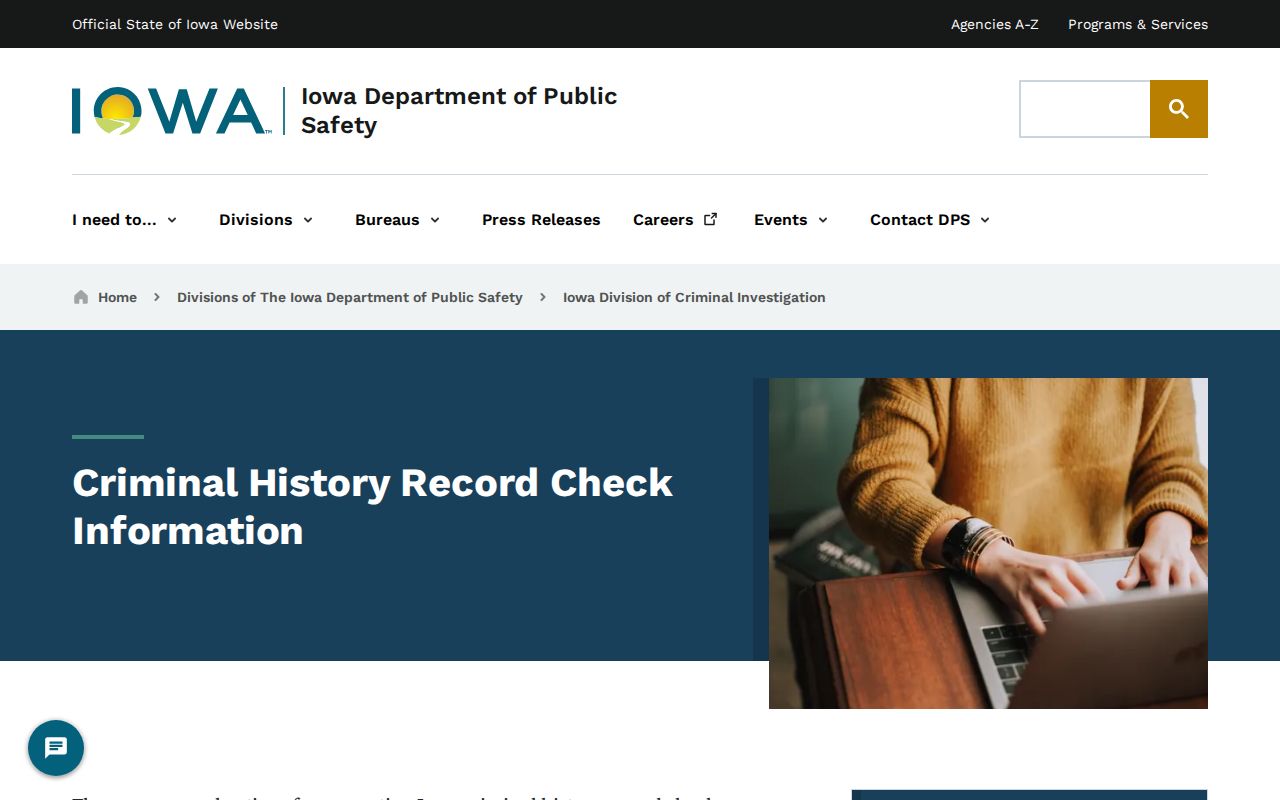
That official page should be checked for current forms and processing guidance before sending payment.
Keokuk County No-Record Results
A DCI response stating that no Iowa criminal history was found has more than one possible meaning. DCI may hold no matching repository record. Information may exist but be barred from public release without authorization. Juvenile information may also be unavailable under Iowa law. A no-fingerprint arrest can fail to create a DCI cycle even when an agency or court record exists.
Disposition reporting matters too. DCI links court outcomes back to fingerprint-supported arrest cycles. If no disposition reaches the repository within four years, Iowa rules require purging the arrest information. Misspelled names, incorrect birth dates, and an unmatched disposition can cause gaps. For a careful self-review, compare the DCI response with the court docket and the originating agency record, then challenge the specific keeper's data if the facts conflict.
The Iowa Record Check Online FAQ explains the limits behind result messages.
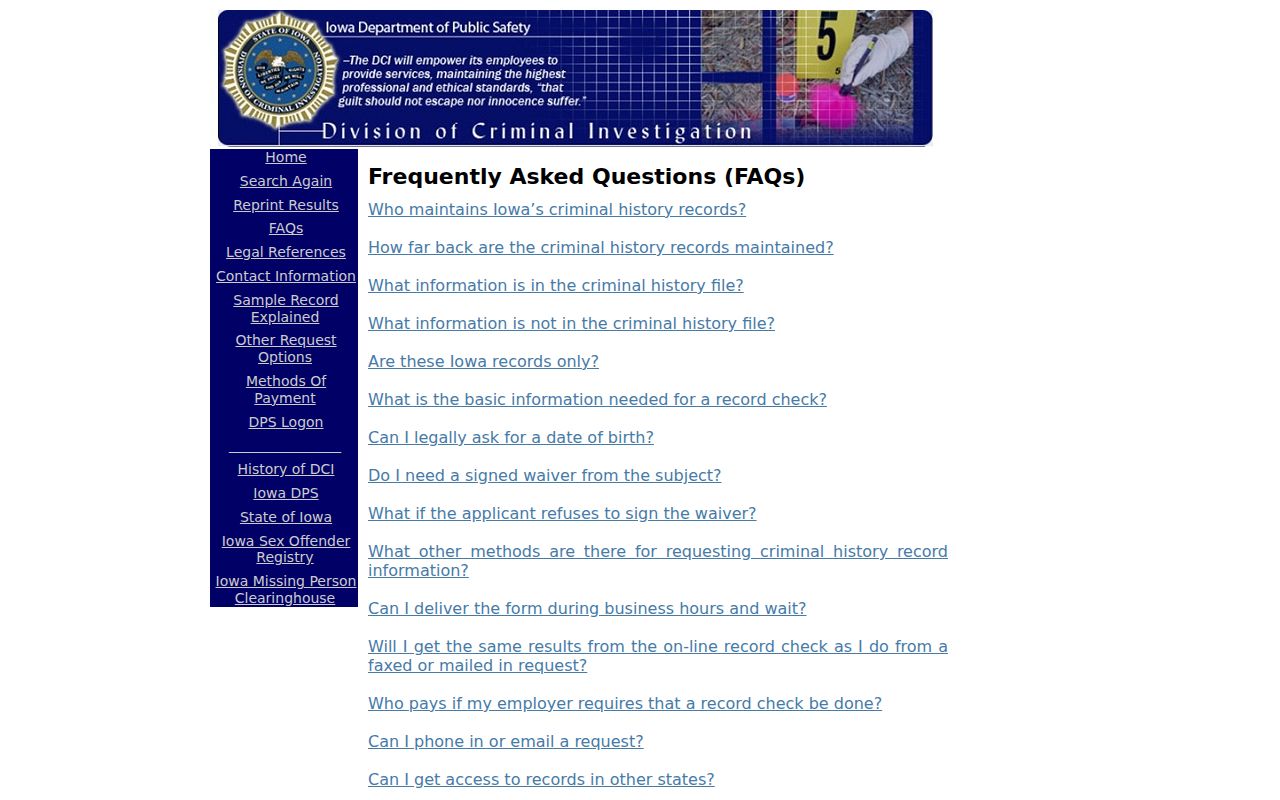
The FAQ makes clear why a repository answer should not be read as a universal search of every court, agency, state, and federal system.
Types of Criminal Records
Keokuk County criminal records differ by creator and purpose. A police report describes the event from the responding agency's view. A booking entry documents intake and custody. The county attorney's filed charge may narrow or replace the arrest label, while the Iowa District Court file tracks the charge through disposition and sentence. DCI organizes reportable history around fingerprint-supported arrest cycles.
- Incident and arrest reports: held by the sheriff, Sigourney Police, Iowa State Patrol, or another originating agency.
- Booking records: created by the Keokuk County Jail and summarized on the current roster.
- Court case files: maintained by the Clerk of District Court, with an informational view online.
- Warrant records: confirmed through law enforcement and the issuing court because no public county list exists.
- State records: DCI holds Iowa criminal history, while Iowa DOC tracks state custody and supervision.
The DCI Support Operations Bureau describes the state repository's fingerprint foundation.
That repository role is distinct from the clerk's case-centered docket and the sheriff's current-custody list.
Keokuk County Booking Snapshot
The sheriff's “Who's in Jail” page is a browse-only roster. It has no name box, booking-number search, filter, export, login, or pagination. Updates appear after 3:00 a.m. and 3:00 p.m., so the page is not real time. Each public entry is limited to booked date, name, age, sex, charge description, and bond.
The roster does not show a mugshot, exact booking time, arresting agency, case number, court date, release date, or the incident narrative. Call the sheriff when a recent intake may fall inside the update gap. Ask that office for older booking material under Iowa Code chapter 22. For state custody or community supervision after the county-jail stage, use Iowa DOC Offender Search. The detailed arrest trail is covered on the Keokuk County arrest history page.
The official sheriff hub links jail and custody services.

It also gives the verified counter for fingerprinting, report questions, warrant confirmation, and registry check-ins.
What a Keokuk County Criminal Record Shows
The amount of detail depends on the product. Iowa Courts Online can show a case ID, type, creation date, judge, party roles, charges by count, filings and events, disposition, financial obligations, and bond data. A DCI record pairs identity data with fingerprint-supported arrest cycles and matched dispositions. The county roster carries only the short custody fields listed above.
| Name and identifiers | Name and date of birth support matching; each public system releases only its authorized identifiers. |
|---|---|
| Arrest and booking | Agency, arrest date, allegations, fingerprints, and intake data may be split between agency, jail, and DCI files. |
| Charges and counts | The court docket identifies each filed count, charge description, and later outcome. |
| Disposition | Conviction, dismissal, acquittal, or deferred judgment must be read for each charge. |
| Money and bond | Costs, fine, restitution, surcharge, payment, bond type, amount, and disposition may appear in the docket. |
| Custody and supervision | The jail roster shows current local custody; Iowa DOC covers sentenced state custody or supervision. |
A record should be read in context. “Arrest” means custody under legal authority, not guilt. “Disposition” is the outcome of a charge. A “deferred judgment” delays judgment under Iowa conditions and has its own release rules.
Keokuk County Records Hub Since 1856
Local history helps explain why so many record routes converge in Sigourney. Keokuk County opened for settlement in 1843 and organized in 1844 after an earlier attachment to Washington County. A long county-seat dispute ended when the official seat moved to Sigourney in 1856. The city was named for poet Lydia Huntley Sigourney, who reportedly sent trees for the courthouse grounds and fifty books for the town library.
Today, the clerk, District Courtroom, and county attorney remain at the Main Street courthouse, while sheriff and jail work takes place nearby on South Stone Street. The official history does not establish a construction year or style for the current courthouse, so those details should not be inferred from a photograph.
The county history page supplies this civic background.

The county-seat account gives useful context without changing which modern office holds a report, docket, or repository response.
Public Access Laws
Iowa Code chapter 22 allows any person to inspect and copy public records, subject to lawful exceptions. A custodian cannot force a requester to appear in person and may handle a request in writing, by phone, or electronically. Reasonable actual expenses may apply. Section 22.3 also calls for reasonable efforts to provide a request without a charge beyond copying when fulfillment takes less than thirty minutes.
Open access does not make every fact public. Active-investigation information, juvenile records, victim details, expunged material, and protected identifiers may be withheld or redacted. Criminal-history dissemination has separate limits under chapter 692. Direct a request to the office that created or officially holds the item, and ask for the legal basis when access is denied.
Key Iowa laws:
Iowa Code §§22.2–22.3 and §22.7 provide public inspection and remote request rights while identifying confidential exceptions.
Iowa Code §§692.2, 692.5, 692.18, and 692.19 govern criminal-history release, confidentiality, subject access, and challenges.
Keokuk County Requests Without a Form
The sheriff publishes no dedicated report-request form, report portal, fee schedule, special ID rule, or turnaround promise. The site's business contact form is for emergency contacts at local businesses. It is not a records request. The safe route is to email, call, mail, or visit the sheriff and first ask whether that office is the custodian.
A focused request should name the incident date, approximate time and location, report or case number if known, involved agency, desired item, requester contact, and preferred delivery format. Ask about redactions, release conditions, a fee estimate, and timing before paying. If Sigourney Police created the report, use the police or City Hall channel. If the desired item is a filed court paper, request it from the clerk instead.
Note: A public-record request asks for an existing record; it does not require an office to create a new analysis or compile an answer.
Sealed, Expunged & Restricted
Redaction removes protected details from an otherwise releasable record. Iowa expungement makes a qualifying record confidential and triggers specified repository action, but it is not universal erasure. Juvenile records, protected victim or minor identifiers, active-investigation material, Social Security numbers, and some registry information are also restricted by separate rules.
Iowa Code section 901C.2 covers qualifying acquittals and dismissals. Section 901C.3 offers a limited misdemeanor-conviction remedy with detailed conditions and many exclusions. The verified conditions include more than eight years since conviction, no pending charges, paid court obligations, and no history of more than two deferred judgments. Relief is generally once in a lifetime, subject to the same-occurrence rule. No general felony expungement was verified.
For a Keokuk County case, review the docket and judgment, then ask the Clerk of District Court for the current Iowa Judicial Branch process. After an order, confirm both the court display and a later DCI self-review. Eligibility depends on the exact offense and case history.
Keokuk County Warrants Need Confirmation
Keokuk County publishes no public warrant database, active list, most-wanted page, dedicated warrant line, or verified amnesty program. An old docket event does not prove that a warrant remains active. Search warrants, sealed matters, juvenile files, and details tied to an ongoing investigation may be confidential.
A person checking their own possible warrant should call the sheriff at 641-622-2727 for current law-enforcement confirmation, ask the clerk at 641-622-2210 about the underlying case, and review Iowa Courts Online for filed events. Ask about present status, bond, and appearance instructions. Iowa's unified court system means there is no separate Keokuk municipal-court warrant database hidden behind the city pages.
Do not visit an office or rely on an old web entry to resolve a possible warrant without first seeking current instructions from the sheriff or clerk.
North English Changes the County Search
North English crosses the Keokuk and Iowa county line. A city name alone cannot identify the right sheriff, jail, clerk, or report custodian. The precise incident location controls where a local report, booking, and filed case should be requested. Iowa Courts Online can bridge counties for a name search, but the official file still comes from the correct county clerk.
Keokuk County lists 17 incorporated cities and gives 2020 Census figures for them. Sigourney ranks first with 2,004 residents, North English second with 1,065, and Keota third with 897. Population supplies geographic context, not a crime rate. The Census county profile adds broader official context, while annual crime statistics should come from Iowa DPS Crime Data in Iowa with the agency, county, and year selected.
The official communities page shows the county list and its population vintage.

Those figures establish which cities receive local pages while the cross-county boundary remains the key record-routing fact.
Criminal Records by City in Keokuk County
City-level records do not all follow one path. Sigourney has a verified police contact, while North English requires location-based county routing and Keota publishes a city records rule without a dedicated online form. None of the three has a municipal criminal court. Filed city charges go into Iowa District Court, while local reports remain with the city or the agency that created them.
Sigourney Criminal History
2,004 residents in the 2020 Census. Police reports start with the city department.
North English Criminal History
1,065 residents in the 2020 Census. Incident location selects Keokuk or Iowa County.
Keota Criminal History
897 residents in the 2020 Census. City Hall is the published records contact.
Keokuk County Record Flow
An arresting agency first creates its incident or arrest report. When an event qualifies for Iowa criminal-history reporting, fingerprints and arrest information go to DCI. A jail intake creates a separate Keokuk County custody record. The county attorney then decides what charge to file, and Iowa District Court creates the case-centered docket. A matched disposition returns to the state repository.
Record flow: Agency report › jail booking › prosecutor filing › District Court disposition › DCI update.
A February 2024 DCI release shows how a county sheriff, state investigators, and a city agency can each create records during one multiagency matter. Each stage still answers a different question. A roster allegation is not the filed charge, and the filed charge is not the final outcome. Move from custody to the clerk or DCI when the question changes to adjudication or repository history.